
When it comes to winter driving, or any driving for that matter, advanced driving instructor Alan Sidorov says we do ourselves a disservice by assuming we are good drivers. You can be a skilled driver or an experienced driver — and Sidorov is both, teaching advanced driving and skid control classes, also racing and doing high-speed development testing for manufacturers. Alan points out, though, that doesn't mean he is always a "good driver." Coming home from teaching a course in Prince George, Alan said he was aware of some concentration lapses, and had to force himself to keep scanning ahead. He also stopped along the Duffey Lake Road and spent a couple of minutes skipping rope to wake himself up.
Alan says, "Okay, some people will find that extreme, but any stretching and exercise can help concentration. My old BMW owner's manual actually had a page of calisthenics recommended for rest areas on Autobahns. If you're zoning out behind the wheel, even a little bit, you have to find a way to fix it. However, sometimes only a nap will do.
"Apparently something like 96 per cent of North Americans think they're better than average drivers — now I hate statistics most of the time, but I love it when they're mathematically impossible, blunt and beautiful like that. In reality it is highly unlikely that anyone will always maintain the levels of awareness, skill, and attitude required to be a good driver. You're only as good as the amount of attention you're bringing to the task at that moment.
"It's like anything, whether you're skiing or riding a mountain bike, on some days you're just more on your game than others."
Everybody has a comfort zone, and training is what helps us when we are beyond that level. The brain needs a program it can follow. Sometimes even the teacher needs a bit of self-nagging.
Once, Alan was driving a prototype Ferrari at Pocono Raceway when the right rear tire blew at 160 miles per hour. He remembers having to coach himself through the skid corrections and to keep himself looking down the track rather than at the guardrail. "Fastest skid I've ever had to correct," he says, "especially since the tire took out the rear suspension. I did not want to be remembered as the driver who crashed a million-dollar prototype."
To that end, Sidorov says it's better to be honest with yourself, to recognize faults and realize that bad things can happen at almost any time.
"It's better to always have a slight level of apprehension behind the wheel. It sounds funny, but if you're too comfortable while driving you get too complacent and you won't be noticing enough. The problem is that driving is a low probability/high consequence activity. It is one of those things at which you can be incompetent for long periods of time until the consequences catch up. When someone tells me they are an experienced driver, I inquire what they have been learning or working on in their driving. Experience alone is just time served."
Sidorov and his company, Sidorov Advanced Driver Training, has been running advanced driving and winter driving courses for 17 years, teaching drivers what to do when things, literally, go sideways. He's an expert on winter driving, and when reached by Pique he was working on a winter tire comparison for the Winnipeg Free Press. The previous week he was in Ontario to test cars for the Canadian Car of the Year award hosted by the Automobile Journalists Association of Canada.
He has a few key pieces of advice for people driving winter roads — a lot which may seem basic, but are proven to work.
1. Scan ahead — "Here's where you run into a kind of weird problem, which has to do with the human genetic makeup, because we are at heart a slow-moving animal. To be able to go faster as we do in cars and planes and on bikes, we have to train ourselves, because it's not in our natural abilities. Most drivers look between three and five seconds in travel time in front of their vehicle. We recommend twelve seconds, or as far as you can see. This is a great way of staying out of trouble."
Concentrate on scanning as far ahead as you can, and be as aware of everything going on around your vehicle as possible, he says: "The number one thing in slippery conditions is to slow down enough to suit traction. In advanced driving, the rule for cornering is slow in and fast out. For winter, change that to slow in, stay on the road. The most hateful thing to do to a vehicle is to enter corner a too fast for the available traction because you will leave the road. That's simply a basic law of physics."
2. Use your brakes wisely — "Whether you are on the track, or trying for the perfect chauffeur stop, or coming to an intersection during winter, the highest brake pressure should be early in the braking zone so you're able to ease off the brake pedal as you approach stop signs and lights." If you can avoid coming to a full stop it can also help you get going again, as intersections tend to be more slippery than the rest of the road as engine heat melts the snow and tires spin after accelerating. Look ahead for patches of snow and gravel that can give you more traction when starting again.
3. Know your vehicle — "Up north a lot of people drive pickup trucks, and as a rule they are among the least stable vehicles on the road, you just can't drive one as though it's a normal car. Even the best pickup truck takes 25 per cent longer to stop in an emergency than an average road car, and as a driver you need to understand you need 25 per cent more room." That said, Sidorov says there's no reason that one car should be safer than another if you take the characteristics of the vehicle into account.
4. Winter tires — There are a couple of options, each of which have their advantages and drawbacks:
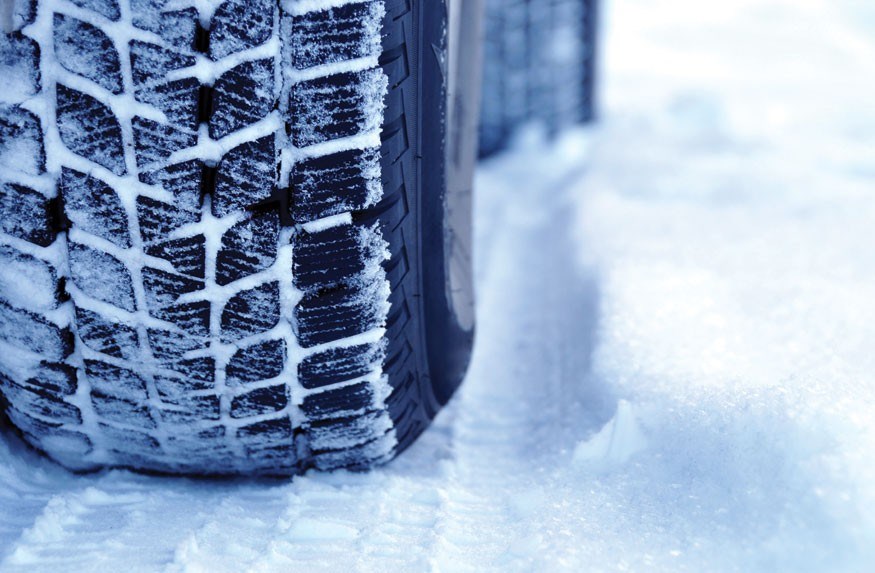
Today's best winter tires are usually studless, made with a soft compound so they don't harden in cold weather. They also have numerous "sipes," (cuts along the rubber surface) for better grip in the rain, ice and packed snow.
Studded tires are good on icy roads, but don't provide any more traction on the snow. As well, they can affect cornering and stopping performance by putting less rubber on the road.
Tires with bigger rubber lugs, which people used to think of as snow tires, are okay when accelerating from a standstill in heavy snow, says Sidorov, but actually have less traction at speed than a proper winter tire.
"It is compounding and tread design that makes winter tires work best," Sidorov explains. "For example, the Bridgestone Blizzaks that are going on one of our vehicles operate through snow-on-snow adhesion, which means they pack in with snow. Think of making a snowball: it actually has pretty good adhesion with other snow."
Something else to consider is tire width. If you have a second set of rims you should use a narrower tire for winter use, which will increase the number of pounds per square inch that you're putting on the road. That's a standard rally driving tactic as well. Narrower tires also work better in the rain, which is common through winter in this part of the world.
As for tire pressure, use the higher of the two ratings listed in your owner's manual or on the door pillar. Check the pressure if weather changes as well because cold will make the air in your tire shrink and appear deflated.
"It seems counterintuitive, but don't be deluded that a squishy tire will work better because it won't," he says.
Chains are good to have, but are generally an emergency option for when you have to drive in the worst of conditions and don't mind staying under 40km/h. You need at least two for your drive wheels, although chains work best on all four wheels.
By law, you need to have winter tires with a minimum 3.5mm of depth. Actually, most winter tires are made with two compounds — the first half is true winter rubber, the second part is more of an all-season mix. Therefore a half-worn winter tire is not going to do the job. Another note on tire wear: if your vehicle's summer or all-season rubber is half worn, your wet weather traction has decreased by at least 30 percent. Understanding this, and adjusting speed and following distance accordingly, is part of being a skilled driver.
The Ministry of Transportation and Infrastructure can designate that winter tires are required on certain roads and roadways. The Sea to Sky Highway is currently exempt, although sections of the highway can be closed to vehicles without chains or winter tires in stormy weather. The highway can also be closed to all vehicles at any time until it can be properly plowed and salted.
5. Brakes over transmission — This is an extension of the first point, but Sidorov emphasizes the importance of braking while driving. "There are a lot of misunderstandings that people have about driving. For example, some people think it's good to use your gears to slow down but that information is about 40 to 50 years out of date. Brakes are for slowing down; gear selection, done before a corner, is for acceleration."
6. Skid Control — Sidorov's winter driving courses involve skid control training. First, he teaches his students how to react in a skid situation — where to look, where to steer, and so on. Then he teaches drivers how to avoid skids using various driving techniques.
Front wheel skids are common, and if the driver responds incorrectly they can become a rear wheel skid as well. Loss of traction at the front wheels is usually caused by too much acceleration or too much braking. "Ease off on the offending pedal, and don't add too much steering. Time acceleration so no significant power is added until you are beginning to unwind your steering input. That is a go-fast tip from the racetrack and a stay safe tip for everyday driving," he says.
In a rear-wheel skid, Sidorov gives this advice:
- More people get into more trouble with the rebound than with the first skid. This is sometimes called "overcorrecting" but Sidorov says it's more of an issue of "under-recovering. Stay off the power. "This is very hard for your average male to accept, but a rear-wheel skid is not a parking lot slide," says Sidorov. "A true skid means the back wheels are seriously trying to pass the fronts. Standard advanced driving rule is 'when in doubt, both feet out.' In other words, when you are still trying to correct the skid, no power, no brakes."
- "Having corrected for the original skid, it's imperative to bring the steering wheel back to your direction of travel as close as possible at the rate at which the skid is diminishing," he says. "Not doing that is why we fishtail, go one way and then the other... I'd rather have people not correct a big skid if they're not ready for part two, which is where you can end up in a ditch or backwards or on your roof."
However, if the vehicle has spun beyond 90 degrees the rule is both feet in. Hard braking, and depress the clutch if applicable. At that point you just want to stop, and this increases your chance of staying on the road. - Knowing where to look is critical for skid recovery. Even if we are looking well ahead while driving, in stressful skid situations we tend to focus our eyesight on the dangers — the tree, the ditch, the vehicle in front of us — rather than the way we should be going or the safe gap that is available. That makes it less likely we will steer effectively and more likely we will panic.
- Push-pull steering is more precise than hand over hand. It has been part of police training for over forty years, and has been required to get a license in Europe for longer than that. Unfortunately, even trained drivers often let skills lapse. In risk management terms this is called drift, and not the fun kind. Drift is a gradual movement away from known safe procedures. "This happens often because less safe procedures are easier, more fun, and we are not immediately punished for being lazy. The proper way to drive is with hands at nine and three o'clock, thumbs resting lightly on the spokes, then use large push-pull steering moves, each hand staying on its side of the wheel. Definitely less painful should the airbag deploy," says Sidorov.
For more on Alan Sidorov and Precision Driver Training, visit www.sidorovprecisiondrivertraining.ca.
Drive systems:
Four Wheel Drive — Still found on many large pickups and SUVs. Some trucks have manual locking front hubs, some hubs lock automatically. Some pickups come with automatic four wheel drive (4WD) with the vehicle's traction management system deciding when it should be applied.
All Wheel Drive — AWD requires a centre differential and is always engaged. However, many AWD systems drive primarily through either front or rear wheels unless a slip is detected.
AWD vehicles generally handle better than 4WD because the systems are quite compact, allowing for a lower centre of gravity. However, for heavy off-road use, a part-time system with low range and locking differentials is a good choice.
It really depends on the vehicle and the conditions, but in Whistler a lot of people have trucks for work and to haul snowmobiles, dirt bikes, etc., and 4WD is extremely popular. Plus the ability to switch to two-wheel drive when traction isn't an issue to save fuel can be an advantage for some vehicles. Having a second gearbox for low and high gear is also an advantage at times, as well as power being distributed almost exactly 50-50 to the front and back. The biggest drawback of 4WD is the stability of the vehicles themselves — higher centre of gravity and rollover potential, light back ends that can slide out, big tires that put fewer pounds per square inch on the ground, longer braking distance and lower fuel efficiency, to name a few.
Front wheel drive — can be an advantage for straight-line traction in slippery conditions, because the weight of the engine and transmission is over the drive wheels. This is a disadvantage, however, on steep hills. Car companies use various computerized traction and stability management systems to keep you from slipping.
On certain rear-wheel-drive vehicles it used to be a good idea to add some weight over the back wheels for more traction, but that's less of an issue than it used to be with some changes to vehicle designs. According to Popular Mechanics, hauling more weight can actually make it harder for your front wheels to grip in some situations, and can make the rear of your car less stable by adding more weight to a drift or slide. However, if you do have a long rear-wheel drive vehicle which is nose-heavy, placing the weight in front of your rear tires will keep the handling consistent. Placing it further back will maximize straight-line traction but will change handling. Secure it so it won't become a projectile if you crash.
Standard or Automatic?
It depends on the driver. The general consensus is that manual (stick shift) vehicles can give the driver better control on snow and ice, but only with a certain level of skill and experience. Most newer vehicles have traction control, and automatics generally have a manual mode or even offer a winter setting, which means the automobile will start in a higher gear.
Winter tune-up — Some engines run better with "winter" oils, and it's a good idea to have your coolant tested. A vehicle may also have issues with ignition wires, distributor caps, spark plugs, etc. that make it harder to start on a cold day. A winter checkup will look at all of your components that could be affected by the cold.
Battery — Get it tested. Batteries have to work harder to start a car in the cold weather as oil thickens, and if your battery is older it may not be up to the task. Some batteries also struggle in extreme cold, as the low temperature slows down the chemical reaction that produces electrons (although most batteries sold in Canada are rated for the winter.) If you notice that it's taking longer to start your car, have your battery tested immediately.
Lights — Headlight bulbs do grow dimmer over time, and should be replaced before they wear out. High beams can actually hurt your visibility in a snowstorm. Never drive faster than visibility allows and leave lots of space if you have to make a sudden stop.
Gas Tank — Newer cars generally don't have as many issues with ice in the gas lines or gas tank as older vehicles, but it happens. Gas line antifreeze can help, as will keeping your gas tank as full as possible to reduce condensation and the build-up of frost and ice in your fuel system.
Doors/Locks — Door locks can fill with water and freeze. Some silicon or Teflon lubricant will help to prevent locks and latches from freezing up and keep your doors opening and closing on the coldest days.
Body — Clear your headlights, taillights, mirrors, roof, front vents and hood of snow and ice before you drive. Make sure your muffler is clear if you back up through a snowbank because it can fill up with snow and stall your engine.
Windows — The police require that all windows be clear of frost and snow, or you can be pulled over and ticketed. Carry a good scraper and brush at all times.
If your windows fog up or have frost on the inside, crack a window while driving to clear out the moisture. You can also leave a window open a crack when parked to even out the humidity. Clearing the snow away from your doors before opening and kicking the snow off your boots will reduce moisture in your vehicle.
Wipers — Good wipers are essential, and winter blades (where the moving parts are covered by rubber) are recommended by the B.C. Ministry of Transportation. To prevent icing and stuck blades, put your wipers up during poor weather. This also makes it easier to clean your windshield of snow and ice. Windshield wiper fluid should be rated to -40C.
Trunk Pack an emergency kit with flares, reflectors, food, water, a blanket, jumper cables, flashlight, window scraper, fuel line antifreeze and extra clothing. Some people like to bring a back-up battery booster, which you can plug into your lighter to start your vehicle if your battery is dead.
Even if you have winter tires it doesn't hurt to bring a set of chains along for extreme conditions. A shovel can be useful digging out a car, as can a bag of road salt, sand or kitty litter. You can also buy traction mats, and in a pinch you can use the floor mats from your vehicle.
Plows Snow plows are a common sight on B.C. highways during the winter. The drivers work long shifts, and are often focused on their snowplow blades and won't notice vehicles passing on the side. DriveSmart BC gives the following advice driving around plows:
- Give plows space as plow drivers have restricted vision. Passing is not recommended in any circumstances, but if you have to then use extreme caution and be aware of the snow cloud — maybe start your wipers before you pass so you don't lose visibility as much.
- Sometimes plows will be dumping gravel and salt on the road. Don't follow too closely, or you could wind up with a chipped windshield.
- When passing on the left, be aware of an additional blade that may extend from the side and may be hidden by the snow.
- Never drive between two plows. They could be working together in that section (e.g. the plow on the left is clearing the left lane, and the plow on the right is clearing snow from the right lane and any snow thrown from the left lane.
Speed — When it's snowing or conditions are poor, the speed limit ceases to matter. While in most cases it's a judgment call, you must reduce your speed and increase your following distance (the Ministry of Transportation recommends a minimum of four seconds between vehicles in winter conditions). The "Speed Relative to Conditions" fine is $167 and three penalty points. "Follow too closely" carries a fine of $109 and three points.


