
It was a sunny day in August when John Barker and his wife Martha drove down the hill into the non-descript Saskatchewan village of Tantallon.
The brilliant, yellow fields of canola dotted the landscape on what was a typical Prairie summer's day.
With its population of about 100, the Qu'Appelle Valley community looked like it had seen better days and Barker wasn't expecting too much.
"There were a couple of ATCO trailers and that was about the centre of town," Barker told Pique recently. "On the right, there was this white rock, six or seven feet high, with 'Douglas Park' hand-painted on it."
The park is named after James Moffat Douglas, a Scottish-born Presbyterian minister-turned-politician who owned a farm in Tantallon and went on to become an MP and Senator.
Barker, a retired North Vancouver forester and university professor, didn't know it but his life was about to change.
"The trailers were the town store and there were groceries piled up on the floor," the 75-year-old Barker remembered. "I went to the checkout and asked the kid, 'Does anyone around here know anything about the Douglases, because he was my great-granddad. This lady came out from behind a pile of groceries and said 'I do. Get yourself a coffee and go and sit down over there.' She was like a sergeant-major."
The woman, who turned out to be the town historian, came back with a plastic bin full of photographs.
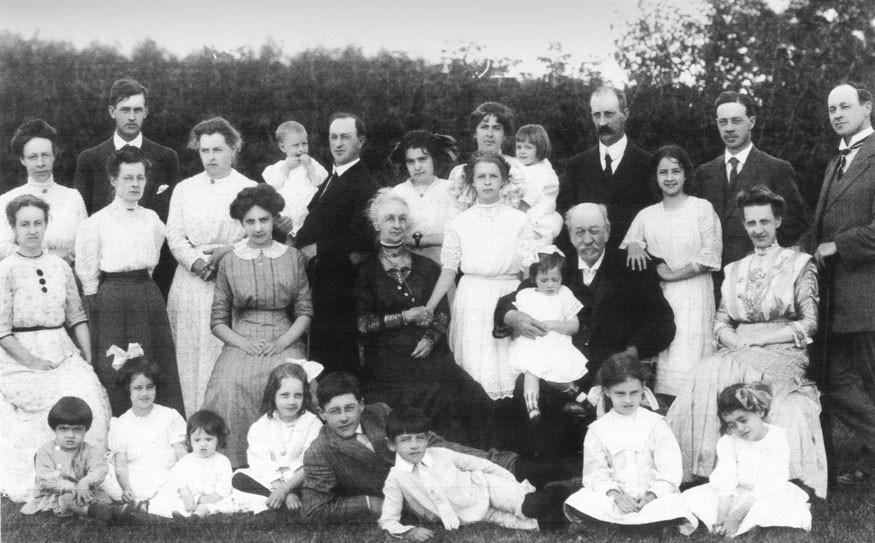
One photo showed the Douglas clan at the Senator's 50th wedding anniversary celebration, taken at the family farm.
"I looked at it and she said, 'We have an overlay with all the names on it,'" said Barker. "She plops this overlay on it and there were all these people that I had names for in my genealogy data base. But there was a lady sitting there, very erect, with a little child in front of her. It was my mother – this little tiny baby. Well. God, I just about cried."
It was the first time Barker had seen his mother Jean's face in more than 60 years.
She had died in a Burnaby car accident, in 1945, when Barker was a seven-year-old child.
The visit to Tantallon in 2006 was part of a "Roots Trip" Barker was taking in a bid to track down his maternal ancestors.
Finding a picture of his mother came as a total shock.
"I could hardly talk, I was so choked up," he added. "I still get choked when I think about it."
Barker is one of legions of B.C. families who have been caught by the ancestry bug.
And this weekend, on B.C.'s first, official "Family Day" public holiday, many will be thinking of their newly found, long-lost relatives.
Although the advent of the Internet has made tracking ancestors a lot easier, it may take years of detective work and pounding the pavement to find the clues that finally unlock the door.
After his mother died, Barker's father remarried.
"My birth mother's family lived back east and I lost track of them totally — I never heard anything," he added. "All I knew was that I was named after my mother's brother, John Elliot Cumming and that my mother's birth name was Cumming."
When Barker's stepmother died in 2003, his oldest son, Michael, chided his father for knowing so little about his birth mother.
"He obviously wasn't happy with that and went back to Ottawa," chuckled Barker. "I got a package on my birthday from him and it had my mother's birth certificate, my mother's and my dad's marriage licence, and a whole bunch of names he'd been searching on the Internet under the surname Cumming."
His son recommended contacting a woman in Los Angeles who sent Barker a package with 85 pages of people named Cumming.
Barker bought an ancestry computer program and started entering names. It took about a year but his mother's side was still poorly represented.
"I didn't have any warm bodies to talk to," he said.
Then he found a connection to a family named Basterfield, who turned out to be a University of Saskatchewan chemistry professor who'd married his mother's sister.
And, because it was an unusual name, that led him to a family named Sherk in Hamilton, Ont., and eventually to a surviving relative who was living in nearby Milton.
So in the summer of 2006, Barker and his wife set out on their "Roots Trip."
It took them to Saskatoon, where they found the Cumming family home, then to Tantallon and on to Milton.
"When we got to Ontario to visit my newly-found cousin there, I downloaded and printed the picture I got in Tantallon," said Barker. "I said, "– Look, what I've got. I've got it with the names there." And she said, 'Thank God,' and she took an original out of her bin. She had the same picture but with no names."
Barker's cousin recommended he visit her aunt in Sacramento, Calif.
"We were going on to visit Martha's relatives on Long Island, so I thought that coming back, maybe we'd take Interstate 40 and come back through Sacramento," he added.
The Sacramento aunt asked Barker if he knew of the Cumming relatives living in Vancouver. One of them, Ian Cumming, is a first cousin.
"It turned out he was a professor of electrical engineering at UBC and he was teaching in the building across the street from the building that I was teaching in," laughed Barker. "And neither of us knew the other was there. It was just amazing."
The two put their heads together and have now come up with 1,900 descendants from Douglas, the original Scot who came to Ontario with his family at the age of 12 in 1851.
Talking of Douglas, Barker enjoys re-telling a funny story about his famous ancestor.
"There was apparently a fire in the Parliament Buildings in about 1914 and they were trying to account for everyone," said Barker. "He was the only one they couldn't account for. They found him later — he was fast asleep in the Senate library. He slept through the whole thing."
Then Barker pointed to a stack of cardboard boxes containing family documents, piled in the corner of his basement office and shrugged.
"It's like a drug," said Barker. "Once you get going on it, you can't stop."
For the Florian family, tracing their history meant taking an emotional tour of Eastern Europe, ending up at Auschwitz, the notorious Nazi concentration camp in Poland.
The family's roots lie in Russia, the Czech Republic and Austria and its ancestors were swept up in the horror that the Second World War brought to European Jews.
Nick Florian, a Toronto-based founder of an international language school, decided in 2010 that it was time his children learned of their family's heritage.
His grandfather, Fritz Reich had died after surviving torture for two months in Block 11, at Auschwitz, in 1942.
"My dad went on this kind of rampage, before this trip," chuckled his daughter Stephanie Florian, who lives in North Vancouver. "He was getting close to 70, so it was like his final party and making sure the kids had this full tour and an understanding of everything that happened."
She remembers her dad having her write family books for show-and-tell in Grade 4.
"What I remember was him telling me about when he was in Prague and escaping from the communists," she said.
The stories of the Jewish side of the family didn't come out until recently.
"Five years ago all these layers came out," she said. "My grandmother was hiding that we had any Jewish blood for so long that it didn't come out 'til close to her death.
Then all this other stuff started coming out."
Eight family members went on the trip, she said, visiting Austria, Prague and Auschwitz.
The tour included the Jewish ghetto in Trebic, where her great-grandfather was and the graves of family members, killed by the Nazis.
But it was in Prague that the family met Nick's cousin Herta, an 88-year-old survivor of four different concentration camps.
"To meet someone like that was a pivotal part of the trip because so much had happened to her," said Stephanie, the host of 24/604, a new lifestyle show airing on Shaw TV. "She was one of those skinny people in concentration camp pictures that had actually survived."
It also helped Stephanie, a mother of two, understand the protective shell that some of her relatives had built around their emotions for years.
"They have such dark history," she said. "We have no concept of what they've been through."
Stephanie's husband, Rod McInnes, said the family got a chance to ask Herta questions.
"Some of the stories were unreal," said McInnes, a manager in the Vancouver video game industry. "She was 19 and her brother Harry was 15 when they got to Auschwitz. She remembers arriving. They'd get off the trains and they'd make the women go on one side and the men on the other side."
Herta told them about the day she arrived at Auschwitz, and saw Dr. Josef Mengele, nicknamed "the Angel of Death" for his brutal experiments, sorting out the prisoners.
"She remembers she was in the line and Dr. Mengele was there, and he would point. If he pointed to the right you were off to the gas chamber and if he pointed left you went to the working side of the camp," added McInnes. "Her brother was pointed to the right. She remembers that at all four camps she always got pointed to the left, which ended up being the safe side."
As the war ground to an end in 1945, Herta went on the forced march out of the concentration camps, when many of the prisoners died.
"It was three days of marching with no food, in winter conditions," added McInnes.
"She said the Canadians had found her. A soldier had picked her up and she weighed 74 pounds and he actually thought she was dead and went to throw her in with the bodies. She said she tried to say, 'Help,' but she couldn't even speak, so she groaned and he realized she was alive."
The Florians went to Auschwitz on a dark, grey day at the end of August .
It was the most emotional part of the trip, said Stephanie.
"My great-grandfather died in Block 11," she said. "We still don't really know what happened. You just want to know. If only those walls could talk."
Block 11 was the "prison within a prison" where prisoners were tortured and experimented on.
"For men, there was a 'standing cell,' 90-centimetres by 90 centimetres. They put four men in there and there's only enough air for one man," said Nick Florian. "Or they experimented on how much gas you needed to gas one person, so they could figure out how much they needed for the gas chambers. That's where my grandfather died. He went in there on Dec. 14, 1941 and died on Feb 18, 1942."
The Florians saw the concentration camp's grisly exhibits, including piles of hair, spectacles, canes, shoes and brushes as well as the empty cans of Zyklon B, the deadly gas used on prisoners.
But it was when the family was taking a tour of Block 11, in Auschwitz, that a mind-boggling coincidence took place.
As their tour group was being led through by a guide, McInnes broke away to look at an exhibit.
"I looked at this one display case and happened to look at this one-page manifest of the arrival of prisoners in Auschwitz," said McInnes. "Nick's going, 'Rod, over here,' telling me to come and listen to the tour guide. I'm looking down at this document and I see this name."
Out of the 1.3 million people estimated to have gone through Auschwitz, the page of 30 names included that of Nick Florian's grandfather.
"We knew it was him because his prison number matches the one on the picture we have and it showed his birth date, that he was born in Trebic and that his job was a furrier," added McInnes. "All of a sudden there was this document of the day he arrived in Auschwitz. It was pretty crazy."
The discovery was too much for everyone.
"We were all crying," said Stephanie. "It was an accumulation of all this stuff. It was like a really stark feeling."
When Stephanie gave birth to her second son, Presley, 19 months ago, she gave him the middle name Fritz, in honour of her great-grandfather.
"It's like you've passed on this thing too, when you pass on a name like that, a name that carries so much weight," she said. "Presley's such a happy little soul that it just blows me away that any person could be put through this, let alone a member of your own family."
Every clan has a member who is the keeper of the family tree.
In my case it was my father, Thomas Inwood, who went searching for our ancestors.
After he took early retirement from his London job as a municipal manager, he decided it was time to add a few roots to the family records.
Because he was operating in the pre-Internet age, that meant travelling to churches across the south half of England, and searching through parish registries for records of births, deaths and marriages.
He tracked his family back to 1790, when a Richard Inwood was born in Basingstoke, and who went on to become a sawyer in Chatham Dockyard in Kent.
My father's typewritten family tree includes this frustrated note: "There is a marriage record of a John Inwood marrying a Joanne Hall in Basingstoke 3.11.1717 but so far I have been unable to trace a link with the first named Richard Inwood above."
As far as I know, he never did.
Meanwhile, my mother had always told me stories of being brought up by her grandfather when her parents died after spending time in India.
This was no ordinary grandfather. Sir Owen Pennefather Lloyd had won the Victoria Cross, the highest medal for bravery issued in the British Empire and Commonwealth, she said.
In the mid-1990s, after living for more than two decades in Canada I was on a visit home to London and decided I needed to find out more.
I'd been told there were records kept at the Royal Army Medical College on Millbank, just down the road from the Houses of Parliament.
On a rainy October day, I showed up unannounced at the guard post and asked to see any records of my great-grandfather's valour.
An adjutant marched over and escorted me into a small, dimly lit museum next to the officer's mess.
He handed me a binder that contained a typewritten account of the Jan. 6, 1893 battle in the Kachin Hills of what was then known as Burma, now Myanmar.
Grandfather Lloyd, by then a Surgeon-Major in the Royal Army Medical Corps had been part of the Sima Post garrison of 275 men, which was attacked by 500 Kachins.
Lloyd's commanding officer, a Capt. Morton, had gone out to fight off the attack and was shot in the stomach about 80 metres outside the fort.
Lloyd ran out, under heavy fire, to help him and, helped by another soldier, carried his wounded captain back to the fort through a hail of bullets.
Morton was shot in the abdomen for a second time and died as they reached the post.
Lloyd then took over command of the fort until the garrison was relieved.
I laboriously copied down the account and then was shown, hanging high up on a wall, amongst dozens of paintings, a small, framed depiction of the battle.
As I left, the adjutant pressed an envelope into my hand with a photograph of the painting. I keep it with my personal papers, as a precious memento of a journey back to my family's past, a journey that probably wouldn't happen today, as all the information about my great-grandfather is now available online.
When Suzanne Fournier was growing up on the outskirts of Calgary, her father's family history was always shrouded in mystery.
"When we were little, for a number of reasons, he told us he came from France near the French-German border," said the semi-retired Vancouver journalist.
But on a visit to Expo 67 in Montreal, the family was greeted by a group of 20 relatives when they got off the train.
"Clearly, there had been this large family in Quebec that he had kept secret for his own reasons," said Fournier.
When her father reached 65, he didn't have a birth certificate and applied for one from Quebec, where a parish priest sent a hand-written copy, which gave the details of his birth.
After her father died, in 1981, Fournier wondered what the real family history was in Quebec.
"By the time my father could have spoken about it, he chose not to," said Fournier. "I guess I just didn't know. I really wanted to get a sense of where we were from."
Six years ago, with the help of her daughter Naomi, who is fluent in French, the two set off to find out.
"The Catholic Church keeps minute track of everyone who comes into the country," said Fournier. "We went to the archives in Sherbrooke with just one piece of paper. It opened a trove of documents, some online and some in parish registries, so you are looking at the priest's handwriting."
With two days of help from an archivist, it turned out Fournier had seven generations of ancestors living in Quebec's Eastern Townships.
"We basically went back to the 1600s and we traced my father's people to Paris on the one side and Lyon on the other," she said. "There the records in Canada ended."
But that wasn't the end of the journey.
"Then we did an amazing thing," said Fournier. "Armed with those documents, we drove to every single parish in the Eastern Townships that was mentioned in them. The graveyards were amazing."
The first one the mother and daughter went looking for was the grave of Fournier's grandparents.
"My daughter walked straight to this gravestone and it was my father's parents," she said. "My father was born in 1906 and his parents were born in the mid-1800s and there were their names and it was a bit eerie. Looking around we found the uncles and we found infant children."
Fournier's father's hometown was Roxton Pond, a mainly French community where his parents had owned a huge dairy farm.
"We drove round there and found streets that were named after his family," added Fournier. "We went to four or five other parishes and found successive generations. It was kind of like an open book waiting to be discovered."
It doesn't always take a journey to make contact with your roots.
For North Vancouver actor Bill Lawrie, it came the via social business network, LinkedIn.
Lawrie had known since he was young that he was adopted.
"We were all gathered around for Thanksgiving or Christmas, and I guess I was probably 11," he said. "My cousin was about nine, and we were sitting around the table, the whole family, my uncles and aunts and my cousins and my family, and he pipes up, out of nowhere, 'How does it feel to be adopted?'"
Lawrie said his mother went ghost white and whisked him off to a bedroom to explain that he was "their little, adopted boy."
Lawrie said it made zero impression on him whatsoever.
"All I could think was that I wanted to get back to the dinner table to finish eating," he grinned.
Fast-forward to about three years ago.
"I had been working a night shift and came home at 4 a.m. and there was an email in my in-basket," said Lawrie. "It said something to the effect, 'Looking for William Lawrie. I may be your cousin from your biological mother, Frieda Sawatsky.'"
When his adoptive mother passed away, Lawrie had found his adoption papers. So he knew that his birth name was Ronald Sawatsky and that he'd been adopted at Burnaby General Hospital.
The name fit, so he printed off the email but thought it might be some kind of scam.
When he contacted the email writer, who turned out to be a birth cousin living in Toronto, she told him she'd traced him through LinkedIn.
Lawrie learned that his biological mother was still alive and living in Chilliwack and had asked relatives to try to track down her son.
And it turned out that, after giving up her son for adoption, Frieda Sawatsky had adopted two daughters of her own.
Lawrie has met one of them but he never did meet his birth mother.
"She didn't want to meet me, for whatever reason," he added. "She obviously had the motivation to look for me but, when she found out I was findable, she decided she didn't want to see me. The feedback I got was that she might have had some micro strokes and was having difficulty speaking. She didn't want to meet me in the mental condition she was in. She passed away 18 months ago."
Lawrie still doesn't know who his natural father was.
"That was information she took to her grave when she passed away a couple of years ago."
For East Vancouver family doctor, Laurie Martz, it took a trip to the Maritimes to accidentally connect her with her family roots.
Her father Joseph was born in Poland, one of seven kids — six of them born in Poland — and lived in a little village called Klimintov.
They were Polish Jews and ran a meat wholesaling business.
In about 1926, said Martz, her grandfather Morris Martz came to Canada alone and settled in Montreal. His wife and children followed the next year.
After landing in Halifax, the family joined Morris in Montreal, where Martz grew up.
"My father never talked about it much and he died 20 years ago," said Martz.
"I was in the Maritimes a couple of years ago — my daughter Naomi goes to school in New Brunswick — and we were in Halifax and there's Pier 21, the immigration museum."
Pier 21 was the port of entry for hundreds of thousands of immigrants, Canada's equivalent of Ellis Island.
Martz, 56, and her husband Maury had merely planned to check out the museum.
But as they went in, they saw a door marked "Data Collection Room," and walked in to see what it was all about.
"I'd heard about the Pier 21 Museum but I hadn't decided to go there looking," added Martz.
It seemed too good an opportunity to miss.
"We spent hours in the computer room," she chuckled. "We never made it into the museum. We had to go back later."
Martz only had some very basic information about her family.
She knew how old her father was when he came to Canada.
"I knew the surname, which was Marc in Polish, and was turned into Martz by the immigration officials," she added. And I knew my grandmother's first name and that's all I knew."
Helped by an enthusiastic archivist, Martz entered the information, along with a couple of potential years.
"Up popped the immigration log with the listing of all the names and the ages of the kids and the name of the ship they came in on and there was even a photo of the ship," she said. "You hear all these stories but seeing this it's like, 'Wow, that was actually reality. There's the boat. There's their names.' They came to Canada with the equivalent of $3."
She said the room was full of other people doing the same thing.
"It was a very emotional thing to do," she said. "I didn't know all that much about my family roots. I hadn't chased it that much. With the reality of record keeping at the time and Jewish migration, I couldn't go back very far."
So why do people feel so driven to track down their ancestors?
"A lot of it is connection," said genealogy expert Peter Whitlock, of Sardis. "A lot of families are a lot smaller than they used to be and people are looking for other family. A lot of people have lost contact with other members of the family so they're reaching out to see what other members of the family there are."
Sometime it's an interest in how historical facts relate to families, he added.
"There's a whole range of interests out there," said Whitlock, 63. "Genealogy is probably the number one hobby in the world these days."
Whitlock runs a website that contains data on 50,000 people with the same surname.
It operates as a clearing-house for information and several thousand people have contributed their findings to it over the last 40 years.
Whitlock said he started out in 1967, when people had to travel to find out information, rather than using the Internet.
"When you actually go and see the places these people lived and you go in the basement of some ancient mansion in England and realize you're seeing the same stones that your family in the 1600s walked on, it's quite fascinating," he added. "We use it as a reason to travel. We travel all over the world to visit people and places that have some sort of connection."
He said he tries to get to Salt Lake City once a year to access the huge database run by the Mormon Church.
"They subscribe to data bases all over the world," he said. "Last time I was there I downloaded 400 wills. I was able to get them without going to England and sit in a lot of different records offices."
Whitlock said the advent of DNA testing has opened up a whole new way of finding out if people are related.
"I had an African American family that wanted to confirm that they were actually descended from a Whitlock slave owner and DNA actually showed them that," he added. "People want to know, 'Where did I come from and why do other people have the same name as me?'"


